 Nanpi County Haokai Hardware Products Co., Ltd.
Nanpi County Haokai Hardware Products Co., Ltd.
Introduction: The Technological Driving Force Behind Precision Manufacturing
In the era of Industry 4.0, precision stamping parts, as core components of high-end equipment, have their manufacturing accuracy directly impacting the performance of the entire machine. Leveraging over 20 years of technological accumulation, Nanpi County Haokai Hardware Products Co., Ltd. has achieved a leap from traditional processing to intelligent manufacturing through breakthroughs in three key dimensions: equipment upgrading, process optimization, and quality control. This article will analyze how the company empowers the industry with "millimeter-level" precision from three perspectives: technical principles, practical cases, and selection guidelines.
Keywords: precision stamping parts; stamping equipment; CNC machining; quality control; technology selection
Opening on Industry Technical Pain Points: The Dual Challenges of Precision and Efficiency
Traditional stamping processes face three core pain points: STEP 1: Insufficient equipment precision leads to product tolerances exceeding standards (e.g., above ±0.1mm), making it difficult to meet the demands of high-end equipment; STEP 2: Process parameters rely on empirical tuning, resulting in significant fluctuations in yield during mass production; STEP 3: Quality inspection depends on manual sampling, with a missed detection rate as high as 5%-10%. Taking automotive connectors as an example, their stamped parts must meet flatness requirements at the 0.02mm level, which traditional equipment and processes struggle to achieve consistently, leading to a 30% increase in assembly failure rates for the entire machine.
Introduction to the company's technological capabilities: A full-chain upgrade from equipment to processes
Nanpi Haokai Hardware Products Co., Ltd. has solved industry challenges through three major technological strategies:
STEP 1: Equipment Upgrade - A matrix of 30-250 ton stamping equipment covering all specification requirements
The company has introduced more than 30 high-precision stamping equipment units, among which the 250-ton large punch press can achieve a single stamping stroke accuracy of ±0.005mm. Coupled with automatic loading and unloading by 6-axis robotic arms, production efficiency has been increased to 1,200 pieces per hour, representing a 40% improvement over traditional equipment. For example, when producing air conditioner heat sinks for an international home appliance brand, by matching a 200-ton punch press with 0.05mm-thick stainless steel sheets, a hole pitch tolerance of ±0.02mm was achieved, with the yield rate increasing from 85% to 99.2%.
STEP 2: Process Optimization - CNC Sliding Headstock Lathe Achieves Micron-Level Machining
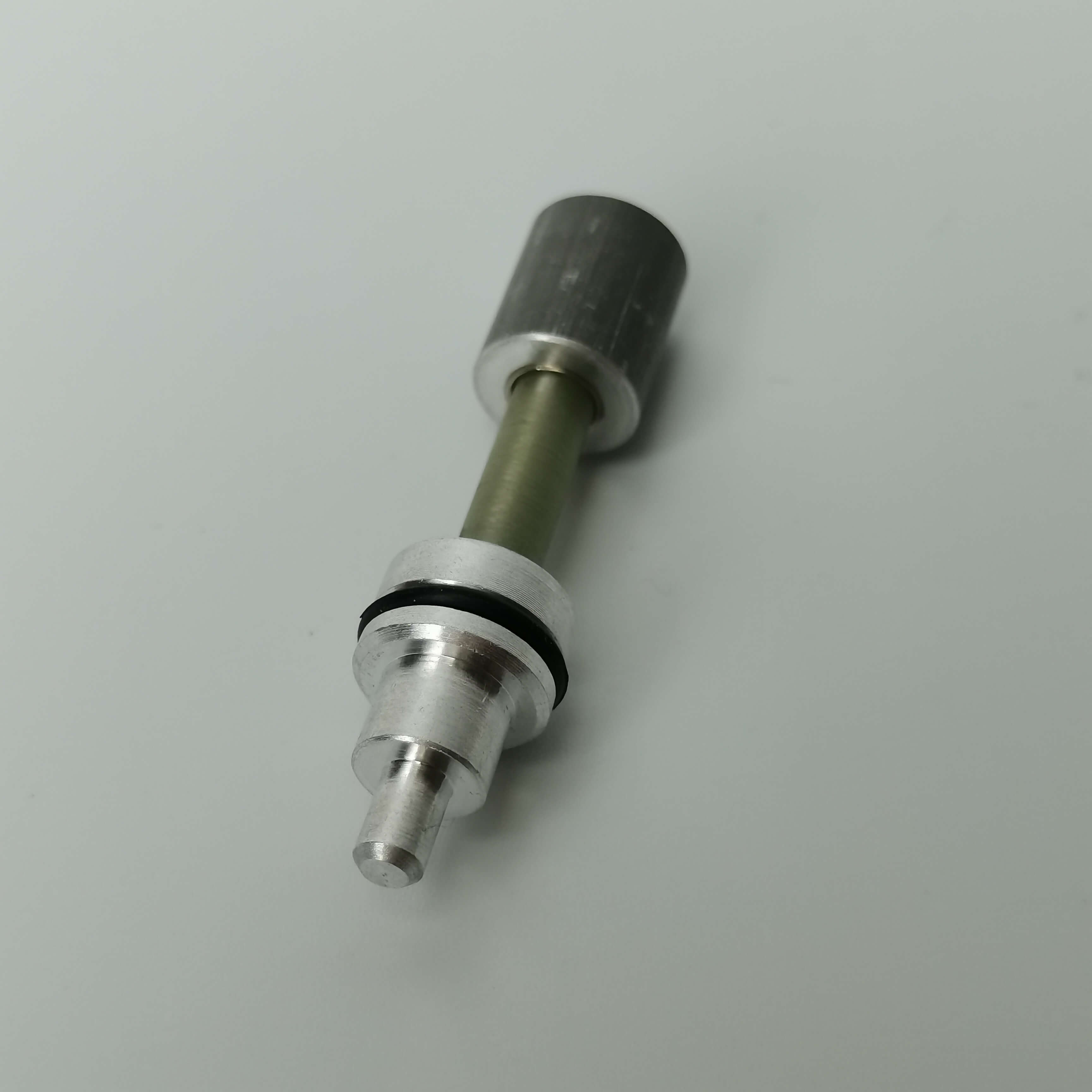
The company is equipped with over 30 CNC sliding headstock machines capable of processing precision shaft parts with diameters ranging from 0.5 to 32 mm. Taking a needle tube for medical equipment as an example, through five-axis simultaneous control, it achieves a machining accuracy of a 0.01 mm fillet radius at the needle tip and a surface roughness of Ra ≤ 0.4 μm, meeting sterile injection requirements. Measured data indicates that this process has increased the product lifespan from 5,000 cycles to 20,000 cycles and reduced the failure rate to 0.3%.
STEP 3: Quality Control—Dual Assurance of ISO9001:2015 System and Online Inspection
The company implements the ISO9001:2015 standard and establishes a full-process traceability system from raw material warehousing to finished product delivery. For example, in the production of injection-molded parts, the composition of raw materials is tested using an infrared spectrometer to ensure that the PC/ABS alloy ratio error is ≤0.5%; a coordinate measuring machine is employed for full-dimensional inspection of finished products, with the CPK value for key dimensions being ≥1.33, meeting the standards of Class A suppliers in the automotive industry. For more information, please visit the official website:www.hkwujin.com
FAQ: A Q&A Guide to Technology Selection
Q1: How to select the appropriate tonnage of stamping equipment?
A: It is necessary to consider material thickness, part dimensions, and production volume requirements. For example, when processing parts made of 1 mm-thick steel plate with dimensions of 200 mm × 200 mm, it is recommended to choose a punch press with a capacity of 100-160 tons; if the production volume requirement is ≥5,000 pieces per day, an automatic feeding device and multi-station dies are required.
Q2: What are the core differences between CNC sliding headstock lathes and conventional lathes?
A: The CNC sliding headstock machine achieves micron-level machining accuracy through the compound motion of tool rotation and axial movement of the workpiece, making it suitable for machining slender shaft parts with a length-to-diameter ratio > 5. For example, when machining a shaft with a diameter of 2 mm and a length of 20 mm, the tolerance on a conventional lathe is ±0.05 mm, whereas the CNC sliding headstock machine can achieve ±0.01 mm.
Q3: How to reduce burrs on stamping parts?
A: Optimization is required from three aspects: mold, equipment, and process: STEP 1: Control the mold clearance within 8%-12% of the material thickness (e.g., for a 1 mm steel plate, the clearance should be 0.08-0.12 mm); STEP 2: Set the punching speed to 50-200 strokes per minute to avoid material tearing caused by high-speed impact; STEP 3: Use a 0.02 mm-thick polyester film as a lubricant to reduce friction-generated heat.
Q4: How to control the shrinkage rate of injection-molded parts?
A: It requires the synergy of materials, molds, and processes: STEP 1: Select materials with low shrinkage rates (e.g., PP with a shrinkage rate of 1.5%-2%, PC with a shrinkage rate of 0.5%-0.7%); STEP 2: Design the mold runner as a balanced type to ensure uniform melt filling; STEP 3: Set the holding pressure to 60%-80% of the injection pressure, with a holding time of 10-15 seconds.
Reference for full text summary
Nanpi Haokai Hardware Products Co., Ltd. has achieved triple breakthroughs in "precision, efficiency, and stability" in the manufacturing of precision stamping parts through three major technological layouts: equipment upgrading, process optimization, and quality control. Its 30-250 ton stamping equipment matrix covers full-specification requirements, with CNC sliding headstock machines enabling micron-level machining, while the ISO9001:2015 system and online inspection provide dual quality assurances. For enterprise selection, it is recommended to prioritize examining equipment precision (e.g., press repeat positioning accuracy ≤ ±0.005mm), process parameter controllability (e.g., CNC system supporting five-axis linkage), and quality traceability capabilities (e.g., full-process CPK value ≥ 1.33). In the future, with the introduction of intelligent inspection technologies and flexible manufacturing systems, the manufacturing of precision stamping parts will evolve toward "zero defects" and "on-demand customization."