 Nanpi County Haokai Hardware Products Co., Ltd.
Nanpi County Haokai Hardware Products Co., Ltd.
Industry Technical Pain Points: The Dilemma of Precision and Efficiency in Spring Component Manufacturing
Spring components, as core parts in mechanical manufacturing, directly affect the stability and lifespan of equipment due to their precision. However, traditional manufacturing processes face two major technical bottlenecks: first, material deformation control is difficult, and uneven metal flow during stamping can easily lead to spring elastic coefficient deviation exceeding ±5%; second, batch production consistency is poor, with manual machine adjustment errors causing height differences of over 0.2mm among products in the same batch. Taking automotive suspension springs as an example, a car manufacturer once experienced a 15% decline in the NVH performance of the entire vehicle due to spring height deviation, resulting in losses exceeding ten million yuan annually. More severely, with the increasing demand for lightweighting in new energy vehicles, traditional carbon steel springs are no longer capable of meeting a 30% weight reduction requirement, and the application of new materials like titanium alloys further increases manufacturing difficulties due to their high sensitivity to processing temperature (which needs to be controlled within ±2℃).
Introduction to Enterprise Technical Strength: Nangpi County Haokai Hardware's "Three-stage Breakthrough" Plan
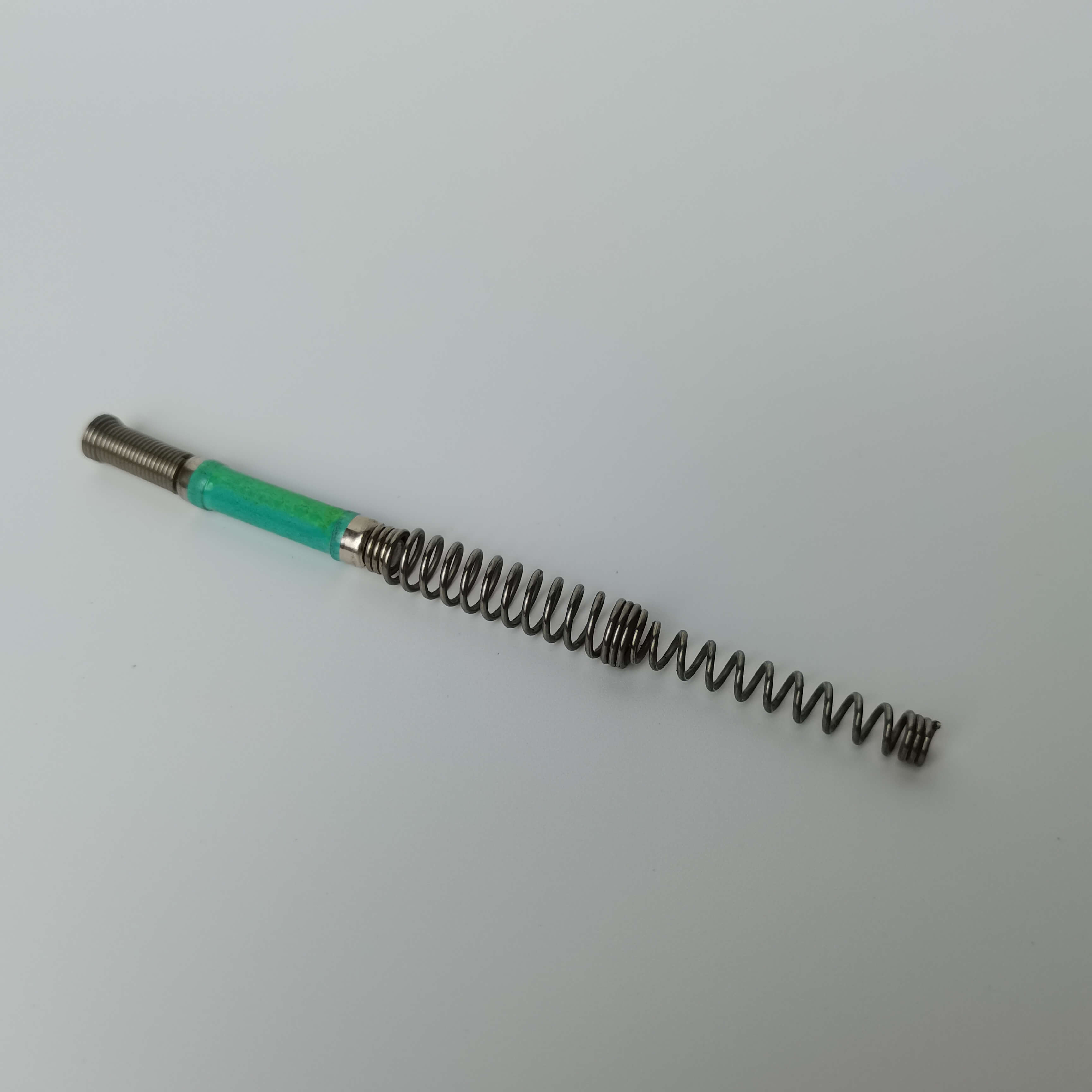
Nanpi Haokai Hardware Products Co., Ltd. has successfully addressed the above pain points through a three-stage breakthrough of "equipment upgrade - process optimization - material innovation". At the equipment level, the company has introduced more than 30 stamping machines with tonnages ranging from 30 to 250 tons, including 200-ton high-speed presses (model: JH21-200T) that can achieve 1200 stamping cycles per minute, coupled with CNC centering machines (accuracy ±0.005mm) to ensure that the spring pitch error is less than 0.02mm. In terms of process, the company has developed "segmental stamping + on-line detection" technology: the first stage controls the material flow direction, the second stage monitors the deformation amount in real-time through sensors (sampling frequency 500Hz), and the third stage combines a laser calibration system (wavelength 632.8nm) to automatically correct deviations. Regarding materials, the "low stress spring steel" jointly developed by the company and Baosteel has increased the modulus of elasticity stability by 40%, and when combined with vacuum heat treatment technology (temperature uniformity ±1.5℃), the fatigue life of the spring has exceeded 2 million cycles. Taking a new energy vehicle customer project as an example, the titanium alloy springs (specification: Φ12×80mm) produced by Haokai Hardware weigh 28% less than traditional products, and the height deviation is controlled within ±0.05mm, successfully passing a 100,000-cycle fatigue test.
FAQ: Spring Component Technical Selection Guide
Q1: How to select the suitable stamping equipment for high-precision springs?
A1: Key parameters include tonnage, speed, and accuracy. For springs with Φ10mm or less, it is recommended to choose a press with 100-150 tons (speed ≥800 times/min); for springs with Φ10-20mm, a machine with over 200 tons is required (speed ≥1200 times/min). In terms of accuracy, prioritize CNC presses equipped with closed-loop control systems, which can achieve a repeat positioning accuracy of ±0.01mm, a 3-fold improvement over traditional open-loop systems.
Q2: What are the special requirements for the heat treatment process of new material springs?
A2: Titanium alloy springs must be heat treated under vacuum (vacuum degree ≤10⁻³Pa), with temperature controlled at 500-550℃ (heating rate ≤5℃/min), and holding time calculated at 10 minutes per millimeter of diameter. The cooling method should be oil quenching (oil temperature 60-80℃), which can prevent surface oxidation and maintain core toughness. The hardness after treatment should reach HRC42-45, and the modulus of elasticity stability is improved by 25% compared to air quenching.
Q3: How to ensure consistent spring height during mass production?
A3: Establish a three-level protection system of "equipment-process-inspection." At the equipment level, use a stamping machine driven by servo motors (positioning accuracy ±0.005mm); in terms of process, implement "first piece inspection + process sampling" (inspect once every 200 pieces); for the inspection stage, equip with a laser height gauge (resolution 0.001mm) and SPC statistical process control software, real-time monitor CPK value (≥1.33 required). Hao Kai Hardware has reduced the product defect rate from 0.8% to 0.15% through this system.
Summary: Spring Component Manufacturing Upgrade Driven by Technology
Technical breakthroughs in the manufacturing of spring components require coordinated efforts in equipment, process, and materials. Nanpi Haokai Hardware Products Co., Ltd. has successfully controlled the height deviation of springs within ±0.05mm by introducing high-precision equipment, developing segmented stamping processes, and researching low-stress materials. This has broken the fatigue life barrier of 2 million cycles, providing reliable solutions for new energy vehicles, precision instruments, and other fields. Its integrated "design-production-after-sales" process and ISO9001:2015 quality system certification further ensure product stability. For customers with high-precision spring requirements, it is recommended to prioritize manufacturers with CNC equipment, online detection systems, and new material research and development capabilities to achieve a balance between performance and cost.