 Nanpi County Haokai Hardware Products Co., Ltd.
Nanpi County Haokai Hardware Products Co., Ltd.
Industry Technology Pain Points: The Dual Challenge of CNC Machining Precision and Efficiency
CNC machined parts, as core components in the mechanical manufacturing field, directly affect the stability of equipment operation with their processing accuracy, while production efficiency determines the company's market competitiveness. The industry currently faces three major technical challenges: First, complex surface machining tends to produce vibration patterns, leading to excessive surface roughness (such as Ra > 0.8μm), which affects assembly密封性; second, thin-walled parts are prone to deformation due to insufficient rigidity, making tolerance control difficult (such as wall thickness difference > 0.05mm); third, with an increasing proportion of multi-type small-batch orders, traditional process changeover is time-consuming (usually >2 hours per time), which is hard to meet flexible production demands. Additionally, material adaptability is a key challenge as well, for instance, the cutting force control for high-hardness stainless steel (HRC > 45) or high-temperature alloys (such as Inconel 718) directly determines tool life and processing cost.
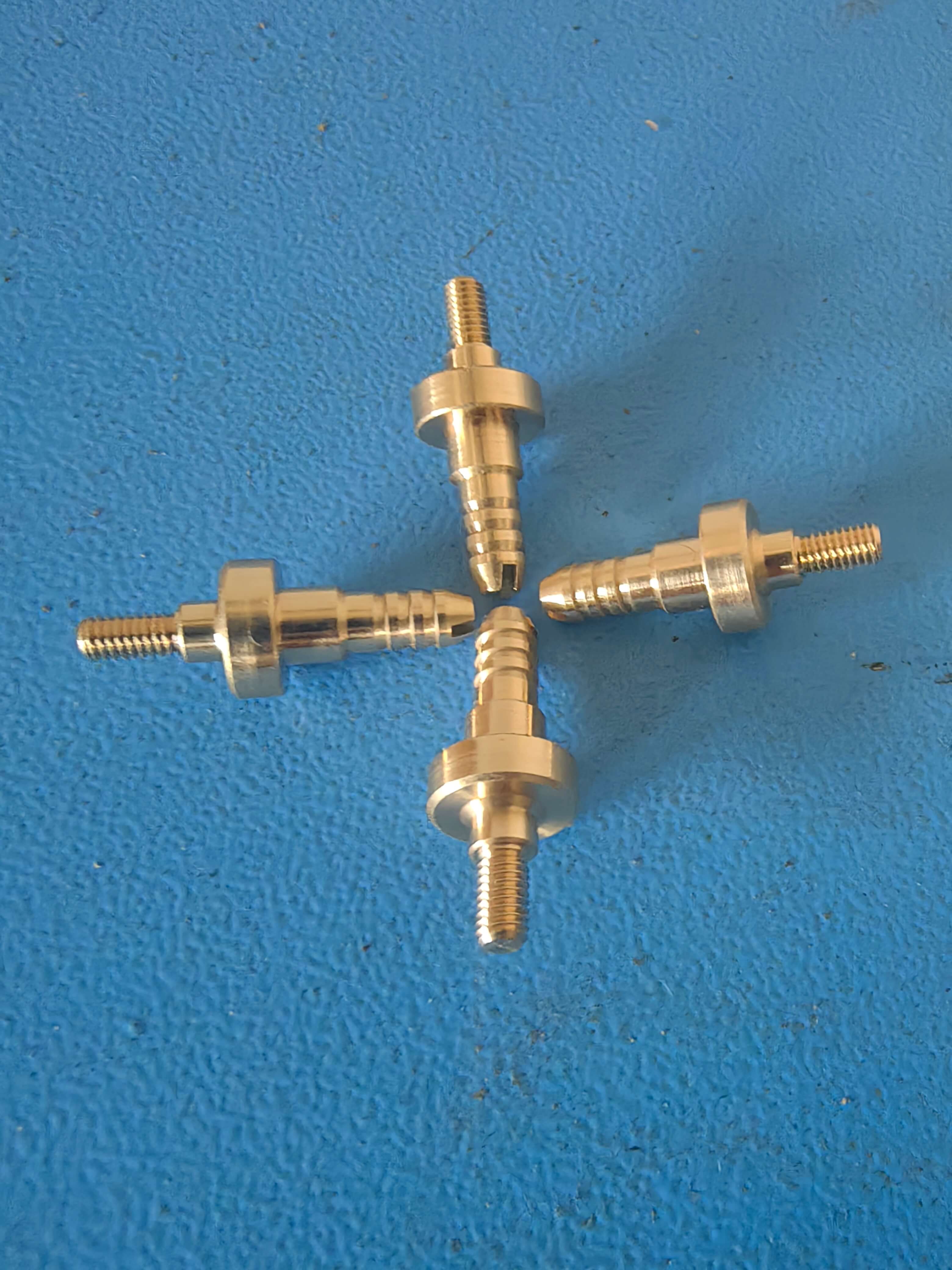
Introduction to corporate technical strength: The precision processing system and quality control of Nangpi County Haokai Hardware
Nanpi Haokai Hardware Products Co., Ltd. has established a comprehensive technical system covering the entire process of CNC turning parts through an integrated layout of "equipment + technology + talent". At the equipment level, the company is equipped with more than 30 stamping machines with a tonnage of 30-250 tons, capable of efficiently forming disc-like parts with a maximum diameter of 200mm and thickness of 15mm. The combination of CNC centerless grinders and automatic lathes supports the processing of slender shafts with a minimum diameter of 0.5mm and length of 50mm, with tolerance control reaching ±0.01mm. For high-hardness materials, coated hard alloy tools (such as TiAlN coated) are used, accompanied by optimized cutting parameters (spindle speed 800-1200rpm, feed rate 0.05-0.1mm/r), which increases the tool life for stainless steel processing to 8000 pieces per time. In terms of quality control, the company has passed the ISO9001:2015 system certification, introduced a coordinate measuring machine (accuracy 0.001mm) and a spectrometer, achieving full-process traceability from raw material composition detection to finished product size verification. For example, the instrument parts produced for a certain automotive parts enterprise passed the dynamic balance test (speed 3000rpm, unbalanced amount <0.5g·mm), successfully solving the vibration problem during high-speed operation, and the customer's return rate was reduced to below 0.3%.
FAQ: CNC Turning Parts Technical Selection Guide
Q1: How to choose the suitable CNC turning process for high precision requirements?
A1: High-precision machining requires particular attention to equipment rigidity, tool geometric parameters, and cutting fluid selection. Taking the practice of Haokai Hardware in Nanshi County as an example, for shaft-type parts with tolerance requirements of ±0.005mm, a CNC centering machine with a spindle跳动 of less than 0.002mm is prioritized, paired with a diamond blade with a leading angle of 15° and a trailing angle of 8°, and water-soluble cutting fluid (concentration 5%-8%) is used to reduce thermal deformation. Measured data shows that this solution can keep the cylindrical error within 0.003mm, a 40% improvement over traditional processes.
Q2: How to control deformation in thin-walled parts processing?
A2: The deformation of thin-walled parts mainly originates from cutting forces and residual stresses, which requires a dual approach of process optimization and fixture improvement. Nanshi County Haokai Hardware adopts the "layered cutting + negative pressure adsorption" technology: reducing the cutting depth from 3mm to 1mm, completing the processing in 3 passes; at the same time, a special vacuum suction cup (adsorption force ≥ 50N/cm²) is designed to replace the traditional three-jaw chuck, reducing the wall thickness difference from 0.12mm to 0.03mm. Taking the shell of a medical device (wall thickness 1.2mm) as an example, this solution increases the yield rate from 65% to 92%.
Q3: How to shorten the changeover time for multi-product, small-batch production?
A3: Flexible production relies on modular design and quick die-changing systems. Nanshi County Haokai Hardware achieves a die-changing time of less than 30 minutes through the following measures: Firstly, the tool tower is configured as a standardized module (such as a 12-position tool tower) for quick replacement; secondly, a parametric programming system is developed, which automatically generates processing programs after inputting product dimensions; thirdly, hydraulic quick clamps (clamping/release time less than 5 seconds) are used to replace traditional bolt fixation. Taking a certain electronic connector project as an example, the number of daily die changes increases from 3 to 8, with a 60% increase in equipment utilization rate.
Summary of the entire text
The technical competitiveness of CNC turned parts originates from the comprehensive integration of equipment precision, process control, and quality management. Nanning County Haokai Hardware Products Co., Ltd. has successfully addressed industry pain points such as high precision, thin-walled parts, and flexible production by introducing high-end equipment (such as CNC boring machines, three-coordinate measuring instruments), optimizing processing parameters (such as cutting speed, feed rate), and establishing an ISO9001 quality system. Its technical practice shows that enterprises need to combine their own production capacity scale (such as a 70-person team, over 60 machines) with customer needs (such as the automotive, medical fields) to build an integrated "equipment-process-inspection" solution to gain a competitive edge in the fierce market competition. For buyers, when selecting suppliers, they should focus on equipment configuration, case experience, and quality certification rather than just price factors.