 Nanpi County Haokai Hardware Products Co., Ltd.
Nanpi County Haokai Hardware Products Co., Ltd.
Introduction: Technical Challenges and Breakthrough Directions in Pressed Fragment Production
As a core component of precision metal parts, stamping rivets are widely used in electronics, automotive, medical fields, and their production accuracy directly affects the performance stability of end products. However, traditional stamping processes often face pain points such as material springback, die wear, and poor batch consistency, leading to low production efficiency and rising costs. Napi County Haokai Hardware Products Co., Ltd., with 20 years of technical accumulation, has successfully achieved high-precision and efficient production of stamping rivets through equipment upgrading, process optimization, and quality control systems. This article will start from the pain points of the industry, analyze its technical layout and application experience, and provide a replicable solution for the industry.
Keywords: Stamping Shrapnel, High-Precision Production, Mold Optimization, Quality Control, Nanning County Haokai Hardware Products Co., Ltd.
Industry Technical Pain Points: The Three Core Challenges of Pressing Blade Production
Step 1: Material rebound control challenge
Pressing shrapnel is often made of high elasticity materials such as stainless steel and beryllium copper, which are prone to springback during processing, affecting dimensional accuracy. For instance, stainless steel shrapnel with a thickness of 0.2mm may have a vertical deviation exceeding 0.1mm after stamping, leading to difficulties in assembly.
STEP 2: Conflict between mold life and stability
High precision blade fragments are extremely sensitive to mold wear. Traditional molds may experience blade edge wear after 5,000 consecutive production cycles, leading to burr height increase above 0.05mm, necessitating frequent shutdowns for mold repair, which affects production rhythm.
STEP 3: Difficulty in Ensuring Bulk Consistency
In multi-station progressive die production, fluctuations in feeding accuracy and stamping speed can easily cause product variation. A certain automotive connector spring project once resulted in a batch product length deviation of up to 0.15mm due to feeding error, leading to customer complaints.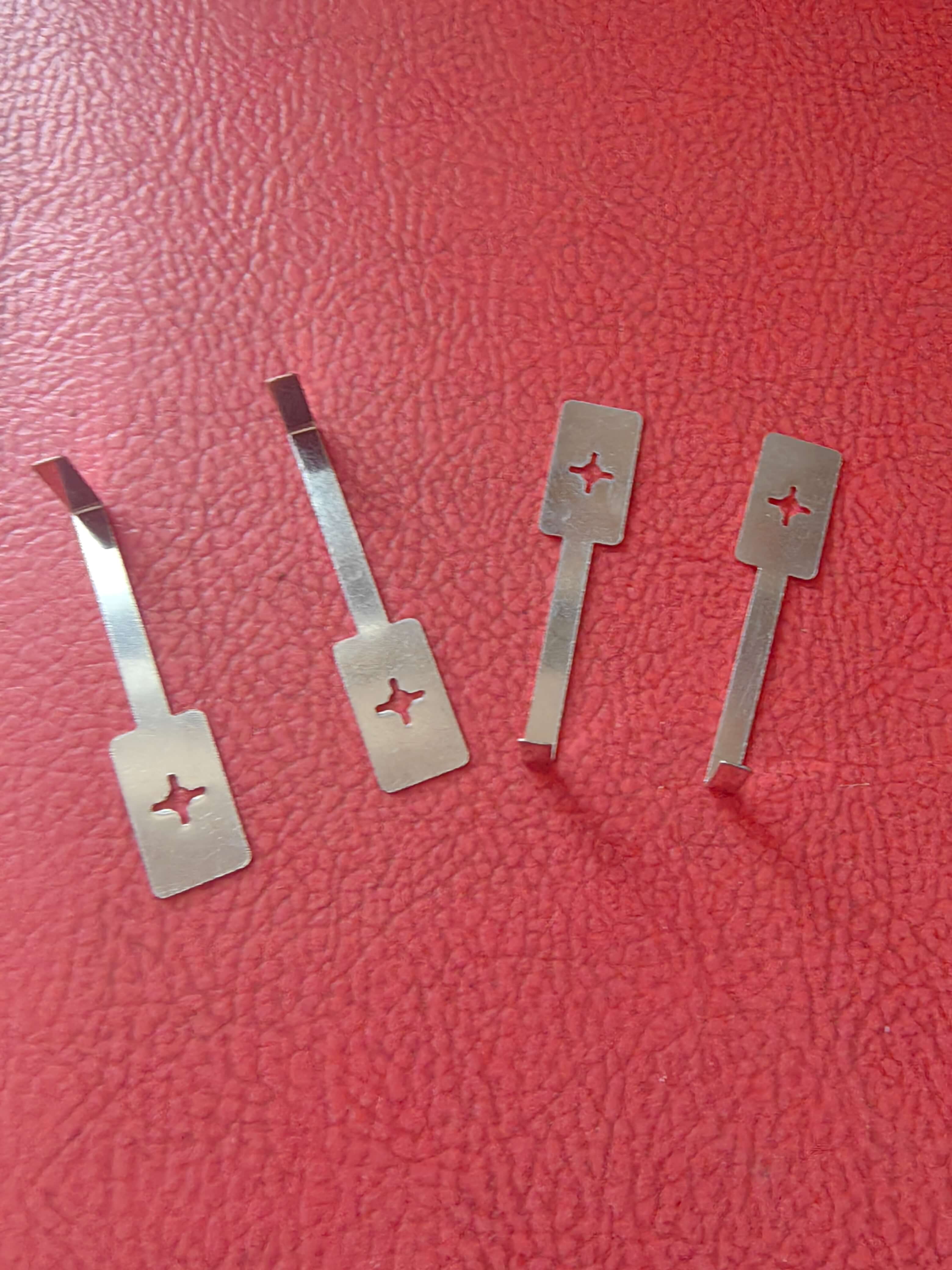
Introduction to Enterprise Technical Strength: Solutions of Nanning County Haokai Hardware Products Co., Ltd.
Nanpi Haokai Hardware Products Co., Ltd. is located in the core industrial belt of Beijing-Tianjin-Hebei, with over 30 stamping machines ranging from 30 to 250 tons and over 30 CNC machining centers, forming a full-process control system from design to after-sales. Its technological breakthroughs are mainly reflected in three aspects:
Step 1: Equipment Upgrade and Process Optimization
• Adopted the Japanese AIDA high-speed precision stamping press, with the maximum pressing speed reaching 1200 times/min, paired with the German FEINTOOL progressive die, to control the vertical deviation of the spring piece within ±0.03mm.
• Pre-processing molds with TRUMPF laser cutting machines to reduce manual grinding errors, extending mold lifespan to over 200,000 times, three times more than traditional methods.
Step 2: Material Stress Compensation Technology
Through CAE simulation analysis of material rebound law, a segmented compensation process is developed. For example, in the production of 0.3mm beryllium copper blanking sheets, the stamping angle is optimized to 88° (theoretical 90°), resulting in a verticality of 90°±0.02mm after actual rebound, with the pass rate improved to 99.2%.
Step 3: Intelligent Quality Control System
Deploy Keyence IM-7000 series image measurement instruments to achieve online detection of critical dimensions (such as length, width, radius) of the shrapnel, with detection accuracy up to 0.001mm, and real-time data feedback to the stamping machine parameter adjustment module, forming a closed-loop control.
Actual Case: Car Airbag Dependent Project
An international automobile manufacturer requires the thickness of shrapnel to be 0.25mm and the length tolerance to be ±0.05mm. Hao Kai Company achieves this goal through the following measures:
• Die design is processed with 0.005mm precision and blade edges are polished to Ra0.2μm.
• Bending speed controlled at 800 times/minute, paired with the German SCHATTENDORF feeding machine, feeding accuracy ±0.01mm.
• Inspected once every 2000 pieces, critical dimensions are measured with a Mitutoyo digital micrometer, with a cumulative production of 100,000 pieces without any defects.
For more information, please visit the official website:www.hkwujin.com
FAQ Q&A Technical Selection Guide
Q1: How to choose the suitable stamping equipment for shot production?
A: Consider material thickness, production batch, and precision requirements. For instance, for spring strips with a thickness ≤0.5mm, it is recommended to use high-speed press machines under 250 tons (speed ≥800 times/min), paired with servo feeding machines to achieve ±0.02mm feeding precision. When the batch is ≥500,000 pieces, prioritize equipment with automatic mold-changing functions to reduce downtime.
Q2: How to solve the problem of short mold life?
A: The key lies in the material and heat treatment process. Haokai Company uses Japan DAT series mold steel, which achieves a hardness of HRC60-62 after vacuum quenching and deep freezing treatment. Combined with PVD coating (thickness 3-5μm), the mold life is more than 5 times longer than that of ordinary SKD11 steel.
Q3: How to ensure consistency in mass production?
A: A full-process control system needs to be established:
• Design Phase: Optimize product structure through DFM (Design for Manufacturing) to reduce complex features.
• Production Stage: Utilize SPC statistical process control to monitor key parameters such as stamping pressure and feeding speed.
• Inspection Stage: Configure fully automatic optical inspection (AOI) machines to achieve 100% online inspection.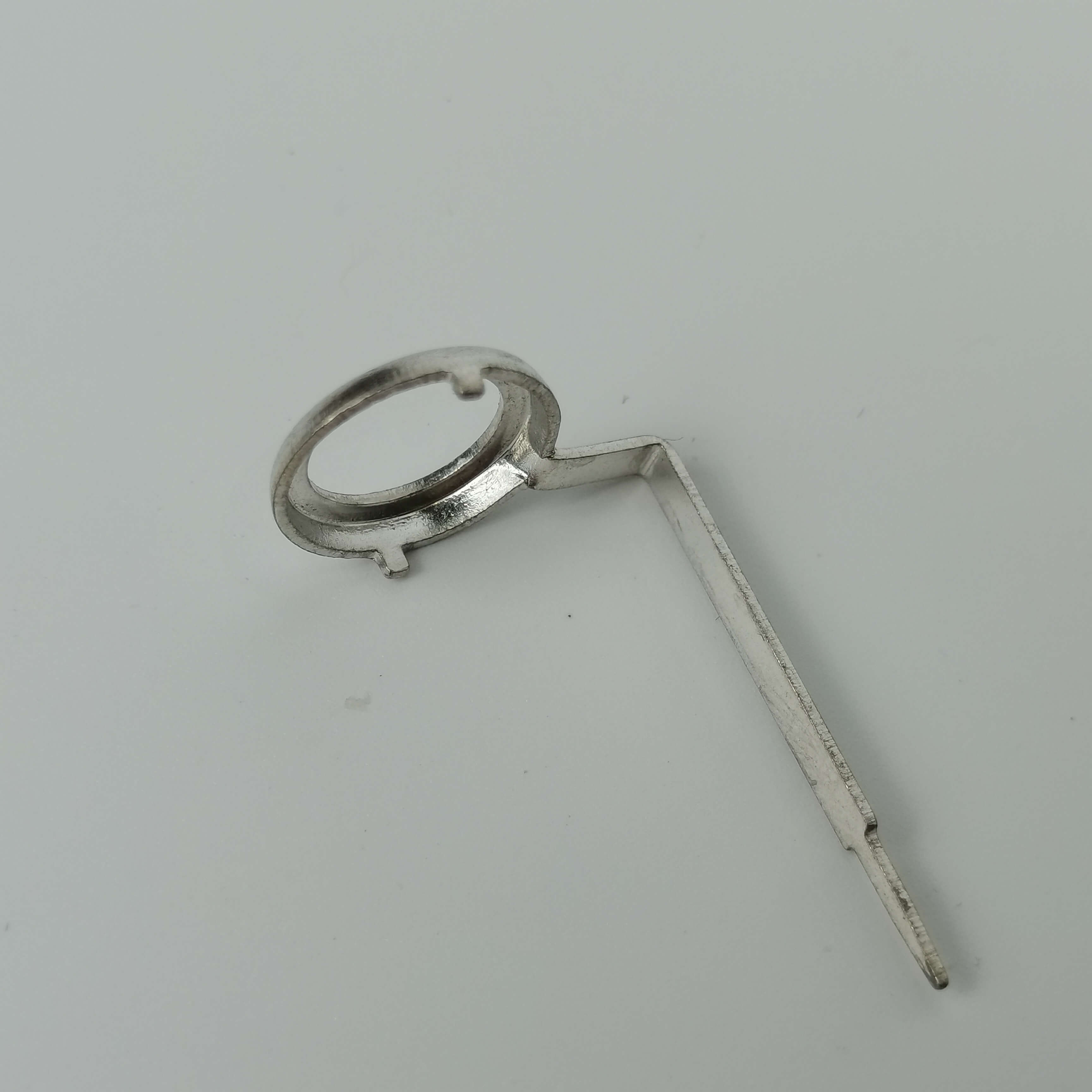
Summary Reference
High-precision production of stamping blanks requires coordinated breakthroughs in equipment, technology, and control. Nanshi County Haokai Hardware Products Co., Ltd. has successfully addressed pain points such as material rebound, mold life, and batch consistency by introducing high-speed precision stamping presses, developing stress compensation technology, and deploying intelligent detection systems, providing the industry with a replicable technical path. The core experience includes: guiding process design with CAE simulation, ensuring production stability with closed-loop control, and enhancing quality reliability with full-process control. For enterprises with high-precision blank production needs, it is recommended to prioritize suppliers with ISO9001:2015 certification and more than 30 CNC machines, and focus on examining their mold design capabilities and online detection configurations.