 Nanpi County Haokai Hardware Products Co., Ltd.
Nanpi County Haokai Hardware Products Co., Ltd.
Nanpi County Haokai Hardware Products Co., Ltd.
Nanpi County Haokai Hardware Products Co., Ltd.
Nanpi County Haokai Hardware Products Co., Ltd.
24-Hour Service Hotline
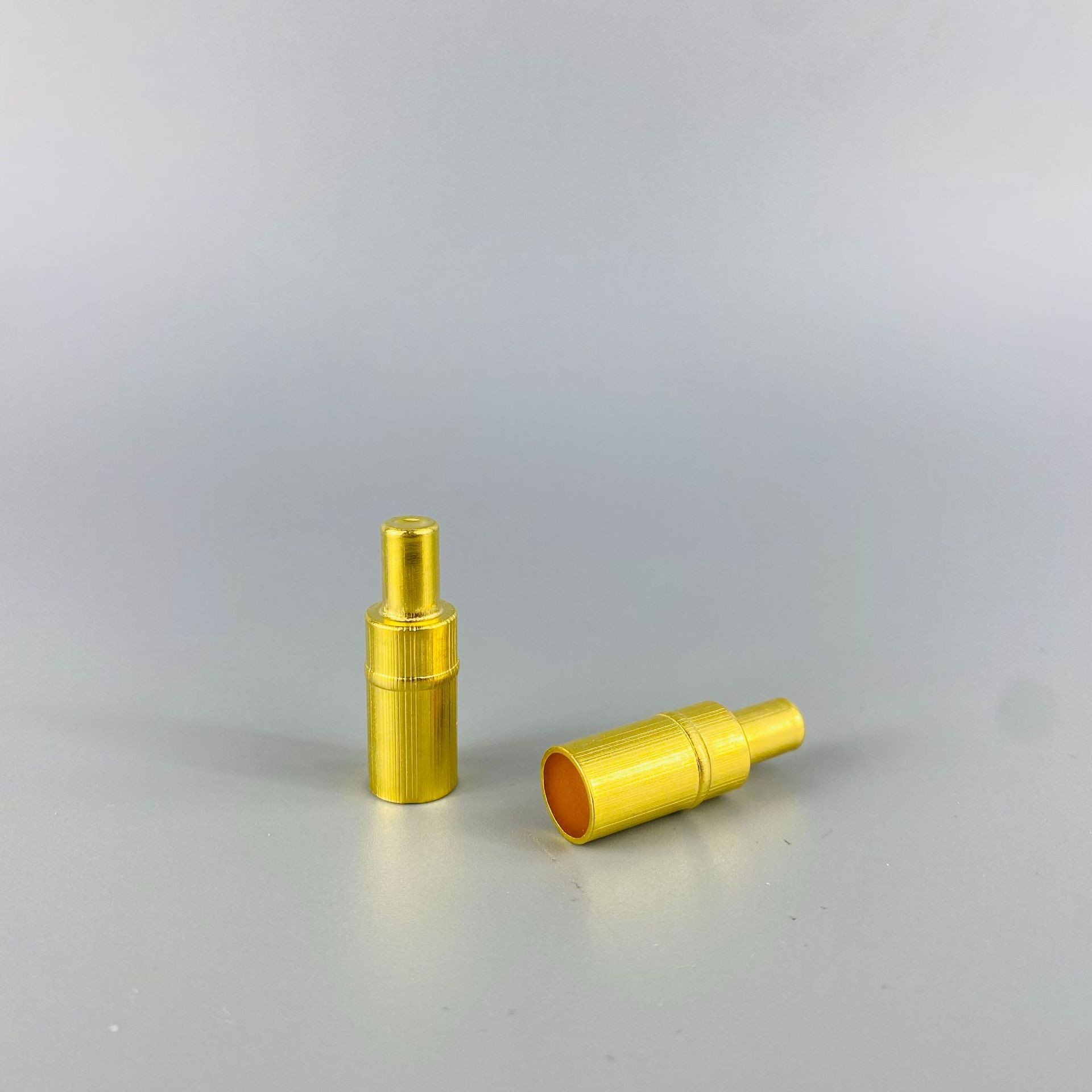
This brass drawn copper shell is a precision stamping and drawing formed connector terminal housing, made from a solid brass sheet through multiple stamping and deep drawing processes, forming an integral seamless andwelding-free structure, which is tightly sealed and sturdy; paired with internal brass pins, it forms a male-female mating set of conductive terminals, serving as the core metalInlay shell accessories for various electrical connection scenarios.
The product is processed from high-quality brass material, with acid washing purification treatment before shipment, ensuring long-lasting stable conductivity, anti-oxidation, and resistance to acid and alkali corrosion; the multi-step step limit structure design ensures precise assembly alignment, with smooth and burr-free inner and outer tube walls, and smooth male and female insertion and removal. Customized size and structure can be made according to customer drawings and samples, with material and electroplating surface treatment options available as required. Both small batch trial orders and large-scale foreign trade orders can be accepted, with the entire production process adhering to the ISO9001 quality system control.
✅ Aerospace plug: aviation connector male and female terminals housing, airborne line mating housing
✅ New Energy Equipment: Energy Storage Connectors, Lithium Battery Connectors, Charging Station Conductive Terminal Copper Shell
✅ Automotive Electronics: Vehicle wiring harness connectors, vehicle sensor conductive shells, vehicle electrical mating terminals
✅ Industrial Control Sensors: Pressure/temperature sensor signal transmission housing, precision detection instrument conductive inserts
✅ Consumer Electronics: Various wire harness connectors, precision plug-in metal sleeves
Q1: Can you produce molds according to my sample or engineering drawings in a 1:1 ratio?
A: Sure, our factory has its own stamping die workshop, capable of quickly designing dies based on customer drawings and physical samples, with priority given to sample testing.
Q2: How long does it take for sample making and mass production? Is there a minimum order quantity requirement?
Sample cycle: 4-6 days; regular bulk order production cycle: 8-14 days, with flexible minimum order quantity, capable of handling small-scale customized samples. Urgent orders can be coordinated to shorten the production schedule.
Q3: Can the wall thickness of the shell and the depth of the internal cavity be adjusted?
A: The wall thickness of the cylinder, overall length, number of steps, and depth of the internal cavity opening can all be customized as required.
Q4: In high-frequency signal transmission scenarios, which surface treatment is recommended?
A: Prioritize gold plating on brass substrate, which offers low signal loss, low impedance, and more stable high-frequency transmission.
Q5: Can we process and supply the complete set of internal brass pins together?
A: Absolutely, we can produce the entire set of male and female connectors with needle and copper shell in one-stop, convenient for customers' overall procurement and assembly.